Where it started
I sit and work for hours, and I felt sluggish all the time.
I have two very active kids, and I felt guilty that I couldn't keep up with their energy. So I built a way to keep moving: every time I reached for a scrolling app, I'd do a quick move first. That became the move goal in Sorry Scroll.
The language goal was my family's idea. They thought those same moments could be a good way to learn a new language.
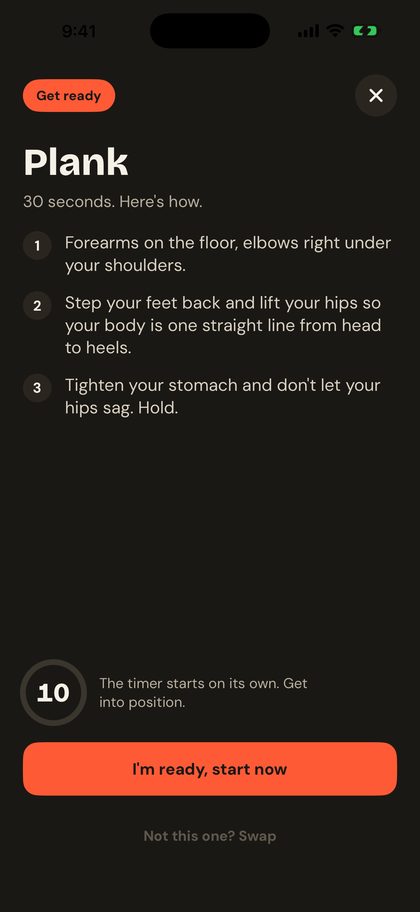
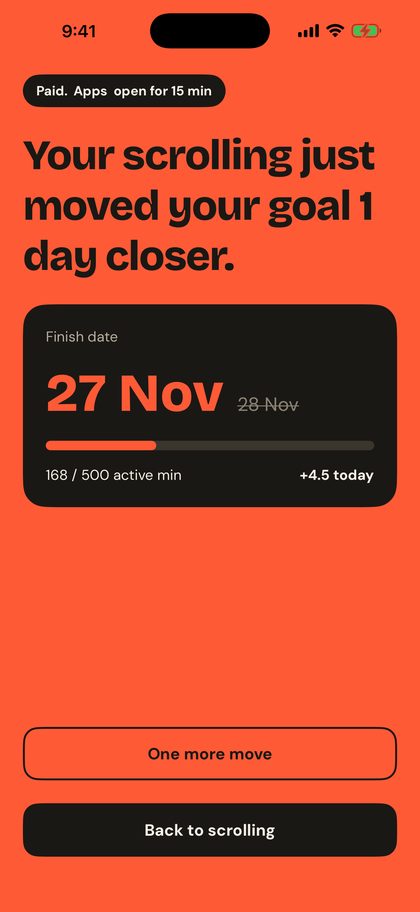
A wall gets walked through. A toll gets paid.
Most app blockers do one thing: they put up a wall. You tap "ignore for 15 minutes" and walk through it.
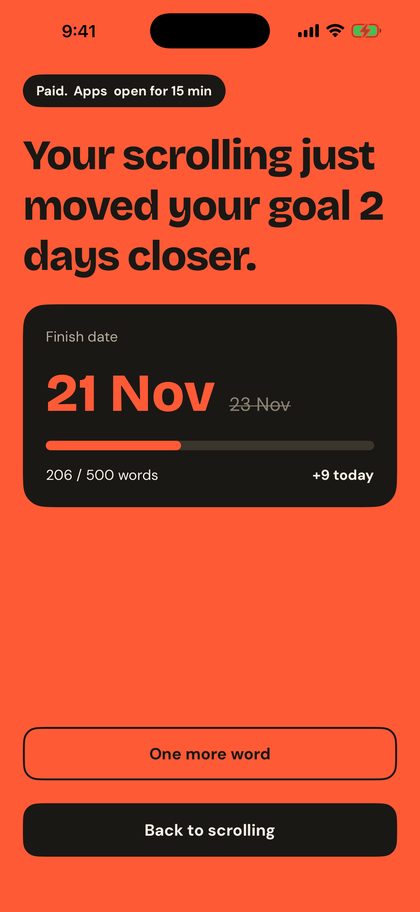
Sorry Scroll makes a different bet. When you open a blocked app like TikTok or Instagram, it asks for one 30-second step first. You learn two words of a new language, do one of 20 quick moves (like squats, a plank, a neck stretch or slow breathing), or play a quick memory game. Then the app unlocks for 15 minutes (you can set up to 60), and every step moves a goal of yours a little closer.
- You open it
A blocked app asks first
Instagram, TikTok, whatever you chose. Sorry Scroll steps in.
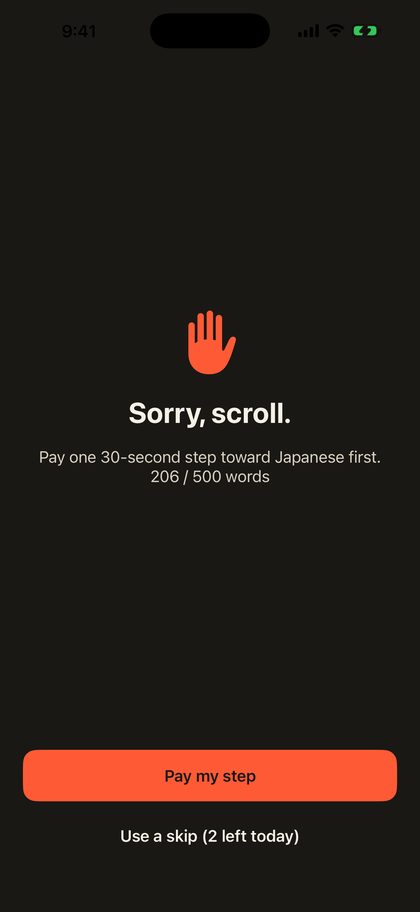
- 30 seconds
Words, a move, or a memory game
Learn two words, do a quick move, or remember a pattern, a few numbers or what's missing.
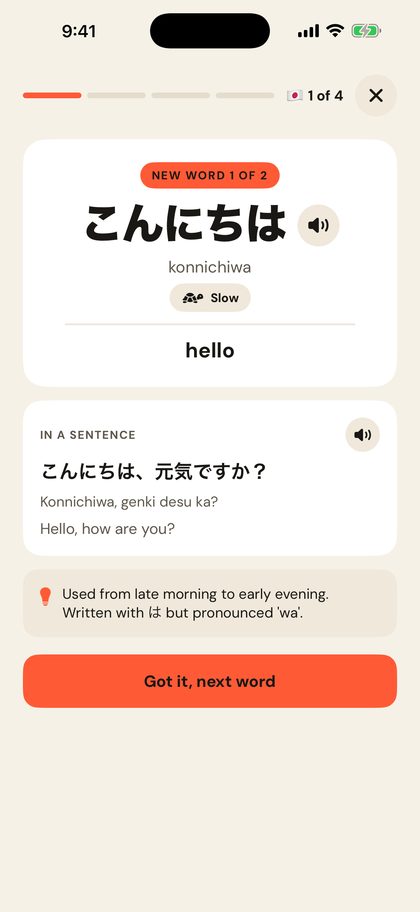
- 15 minutes
You're in, and closer
The app unlocks, and your goal's finish date moves a little closer.
The design rests on five ideas from research. Below is each one, how strong the evidence is, and where it's weak. We haven't run a trial of Sorry Scroll itself, so this is the reasoning behind the app. It doesn't prove the app works.
Your attention is being cut into smaller pieces
Gloria Mark, a professor of informatics at UC Irvine, has spent more than 20 years studying how screens affect our attention. In a 2004 paper, based on 2003 observations, people stayed on a single screen for about two and a half minutes on average. In her studies from 2016 to 2020, the average was 47 seconds.1
The "8 seconds, shorter than a goldfish" statistic traces to a 2015 marketing report that cited an unverifiable source, and researchers have debunked it.2 What the research does show is narrower, and still bad news: our attention is being broken into pieces, and a lot of the breaking is us reaching for the phone.
Heavy short-video use goes with weaker attention and self-control
A 2025 meta-analysis in Psychological Bulletin pooled 71 studies and about 98,000 people.4 Heavier short-form video use was linked with poorer cognition, poorer attention, weaker inhibitory control (the ability to stop yourself), and more stress and anxiety.
The detail that shaped the product: how compulsively people scrolled mattered more than how long. Time spent was only weakly linked to cognition. Addiction-style use was linked nearly twice as strongly.
So the target isn't minutes. It's the automatic, unplanned open. A timer addresses minutes. A pause at the moment you open the app addresses the reflex.
It is correlational, mostly cross-sectional, and much of the cognition data is self-reported. People who are stressed or distracted may scroll more, so the arrow could point the other way. The authors say so themselves. Treat it as a warning sign. Also, a well-known 2017 claim that a phone sitting on your desk drains your thinking power ("brain drain") has failed to replicate,5 so we don't lean on it.
Willpower alone loses, and a pause helps
Economists Hunt Allcott, Matthew Gentzkow and Lena Song ran a large experiment on social media use, published in the American Economic Review in 2022 as "Digital Addiction".6 Their model attributes about 31 percent of social media use to self-control problems. Their evidence: letting people set limits on their own future use substantially reduced it, which only makes sense if people want to use less than they do in the moment.
People want help, then. And help that depends on being strong at 11 pm doesn't get far.
- A chance to back outThe biggest effect
- A short delayHelped
- A motivational messageNo effect found
The best direct evidence is a 2023 PNAS field study of a pause app.7 When users opened a chosen app, the pause app showed a short delay and a chance to back out. 280 people used it for six weeks.
What this does and doesn't tell us:
- It shows that a moment of friction, right when you open an app, changes what you do. Sorry Scroll is built on that.
- It did not test a 30-second task. Swapping the pause for a small activity is our idea, and that study didn't test it.
- One of the three authors built the app the study tested.
The message not working is one reason Sorry Scroll asks you to do something instead of reading a reminder.
What to put in the pause: small steps that count
If the pause is going to exist, it should leave you with something. We picked three kinds of step.
Two words of a new language
Spaced practice, meaning short sessions spread over time, is among the most reliable findings in memory research. A meta-analysis of 317 experiments found spreading practice out beats cramming it.8 In a six-month study of 287 Duolingo learners, how often people practiced predicted progress more reliably than how much total time they spent.9 That study only observed learners; it didn't test 30-second sessions. Our reasoning: a couple of words, many times a day, is the pattern this research favors.
Each dot: one open, one 30-second step, two words practiced
A 30-second move
There are 20 to choose from: squats, lunges, a plank, glute bridges, wall pushups, neck and wrist stretches, slow breathing and more, and plenty work at a desk. The evidence that short movement breaks sharpen your thinking is mixed. A 2026 review of sitting-break studies found that results on attention varied widely: some studies saw a benefit, many saw none.10 We don't claim that 30 seconds of movement will make you sharper. We include it because it gets you out of your chair and out of the scroll posture, many times a day, at no cost. That's the reason I built it in the first place.
A quick memory game
Memory is the newest goal. Each step is one short challenge from three games: remember which tiles lit up, repeat a few numbers, or spot the object that's missing. Get three right in a row and the challenges get harder; miss two in a row and they get easier, so they stay just about doable. The finish line is 300 memory workouts, with a weekly target if you want one.
Brain-training claims have a poor record. A large 2016 review found that practicing a memory game makes you better at that game, but there's little evidence it carries over to everyday memory or intelligence.14 So we don't say it will improve your memory, and the app says plainly that its numbers aren't a measure of memory or intelligence. We include it because 30 seconds of holding something in your head is the opposite of a feed, where everything slides past.
Why a goal, and not just a block
"Use my phone less" is vague, and hard to keep. A goal gives you something to aim at. In Sorry Scroll you pick one, for example "Learn Korean, 500 words" or "300 memory workouts". The app shows how far along you are and the date you'll finish at your current pace, and every unlock moves both. Two findings guided us.
Opening the app is the cue, so there's nothing to remember. Miss a day and you carry on. Each step is small on purpose: 30 seconds is easy enough to do at your worst moment, and it adds up.
What it did on my phone
During testing I used the free plan and blocked the one app I scroll most. This is the app's own screen from my iPhone.
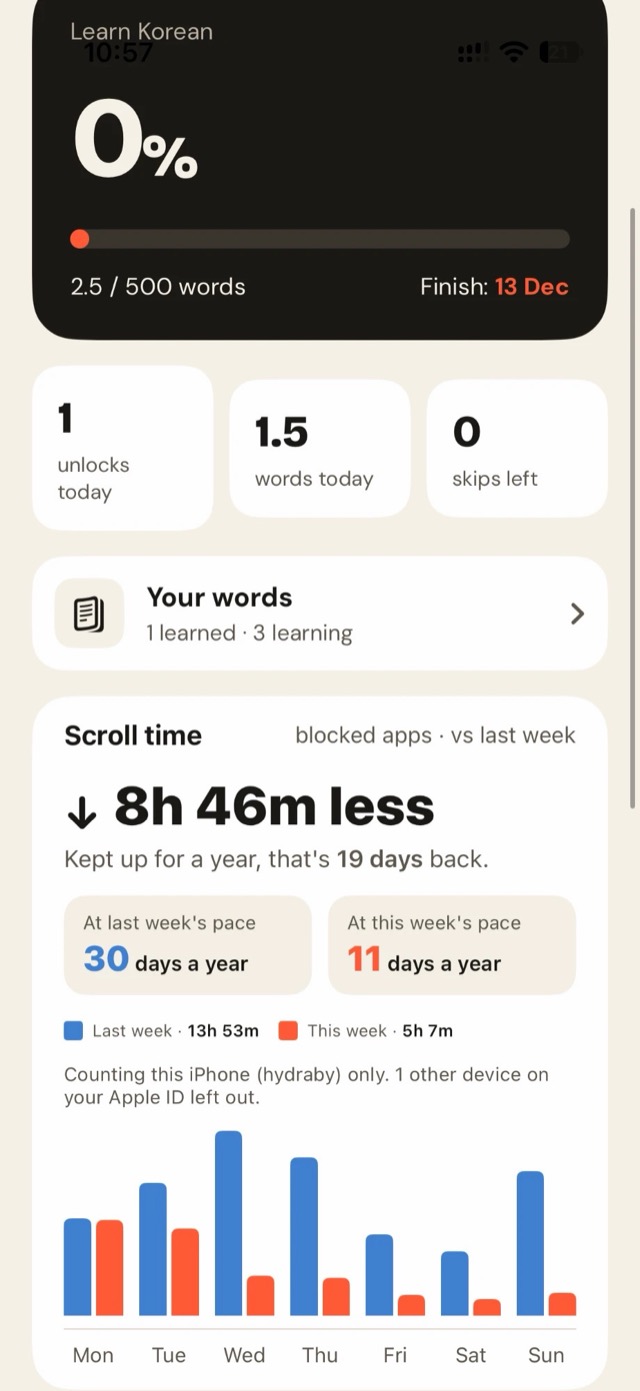
8h 46m lesstime in the blocked app, one week against the week before
The free plan blocks one app. Pro blocks as many as you like, and the other apps that drain my time weren't blocked here. So this shows the effect of blocking one app, not of using the whole product.
It's one person, one week against the week before, with no comparison group. Take it as an example of what can happen. It doesn't tell you what will happen for you.
- The screen counts time in the blocked app only. It doesn't show whether that time moved to other apps, and with only one app blocked, some of it may have.
- The app counts only the phone it runs on. If scrolling moved to another device, this screen wouldn't show it.
- One week can't show whether the drop lasts. A longer run of this chart would be a stronger claim.
- The "19 days back" line is a projection from a single week. It is not something we measured.
What we are not claiming
No trial, no percentage
We have not tested Sorry Scroll in a controlled trial, so we can't tell you it will cut your screen time by any percentage. The numbers above come from one phone, on the free plan, with one app blocked.
Cutting back helps, probably
A 2018 University of Pennsylvania experiment found that 143 students who limited Facebook, Instagram and Snapchat for three weeks reported less loneliness and depression.13 It was small, short, and only in students. It backs the idea of cutting back, not our way of doing it.
Scrolling isn't evil
Gloria Mark lists quitting social media as one option. What she stresses is putting a time limit on it. That's the idea here too: keep the apps, add a price.
The idea in one line
Don't fight the urge with a wall. Give it a tiny toll, and spend it on something you wanted anyway.
Get Sorry Scroll, freeFree on iPhone and Android. Pro blocks every app.
Sources
- Gloria Mark, interviewed by University of California News, "How to sharpen your attention and meet your goals", 2024.
- On the 8-second attention span myth, eLearning Industry.
- Daily time spent on social media worldwide, Statista (DataReportal data), February 2025.
- Nguyen et al., "Feeds, feelings, and focus", a meta-analysis of short-form video use, Psychological Bulletin 151(9), 2025.
- Replication of the "brain drain" smartphone study, PubMed.
- Allcott, Gentzkow and Song, "Digital Addiction", American Economic Review 112(7), 2022.
- Grüning, Riedel and Lorenz-Spreen, field study of a pause app, PNAS 120(8), 2023.
- Cepeda et al., "Distributed practice in verbal recall tasks: a review and quantitative synthesis", Psychological Bulletin, 2006.
- Sudina and Plonsky, "The effects of frequency, duration, and intensity on L2 learning through Duolingo", Journal of Second Language Studies 7(1), 2024.
- Scoping review of sitting breaks, mental load and cognitive performance, Frontiers in Physiology, 2026.
- Gollwitzer and Sheeran, "Implementation intentions and goal achievement: a meta-analysis of effects and processes", Advances in Experimental Social Psychology, 2006.
- Lally et al., "How are habits formed: modelling habit formation in the real world", European Journal of Social Psychology 40(6), 2010.
- Hunt et al., "No more FOMO: limiting social media decreases loneliness and depression", Journal of Social and Clinical Psychology 37(10), 2018.
- Simons et al., "Do 'brain-training' programs work?", Psychological Science in the Public Interest 17(3), 2016.