Turn the habit around
Turn your scrolling addiction into learning (and a stronger body)
Put a 30-second step in front of the apps you open without thinking. Sorry Scroll (sorryscroll.com) does that: every time you open a blocked app, you learn two words of a language or do a quick move first. Someone who opens those apps 25 times a day pays about 18 steps a day: around 9 minutes of learning or moving, without setting time aside.
What 25 opens a day add up to
Using the same numbers the app uses to project your goal:
| With Sorry Scroll | Why | |
|---|---|---|
| Blocked-app opens a day | 25 | An example; use your own number in the calculator |
| Steps paid a day | about 18 | 70% of opens become a step; the rest are skips or closes |
| Time spent on steps | about 9 minutes a day | 30 seconds each |
| Language goal | 500 words in about 6 weeks | 2 new words a step, at most 12 new words a day |
| Active-body goal | about 61 active minutes a week | Each move is 20 to 32 seconds |
Try your own number in the calculator.
Why this works when quitting doesn't
Opening TikTok or Instagram is automatic: your thumb is there before you've decided anything. Blockers that ban the app ask you to fight that reflex every time, and a block you resent is one you'll find a way around. Sorry Scroll keeps the reflex and changes what it costs. The open still happens; it just pays for 30 seconds of something good first.
Some opens you'll skip, because they weren't worth 30 seconds. That's the habit getting smaller on its own. The rest turn into words and moves.
There's evidence for the first half of this. In a six-week study of one sec, a 10-second pause before an app opened led people to close it 36% of the time and cut actual opens by 57%. Sorry Scroll uses that same moment, but it asks for 30 seconds of progress instead of a wait.
What you see
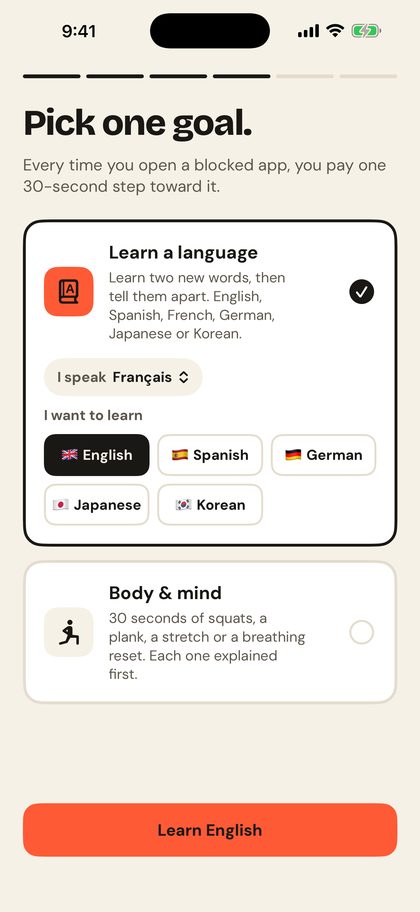 Pick one goal. A language, or moves and breathing. One goal at a time keeps every step pointing the same way.
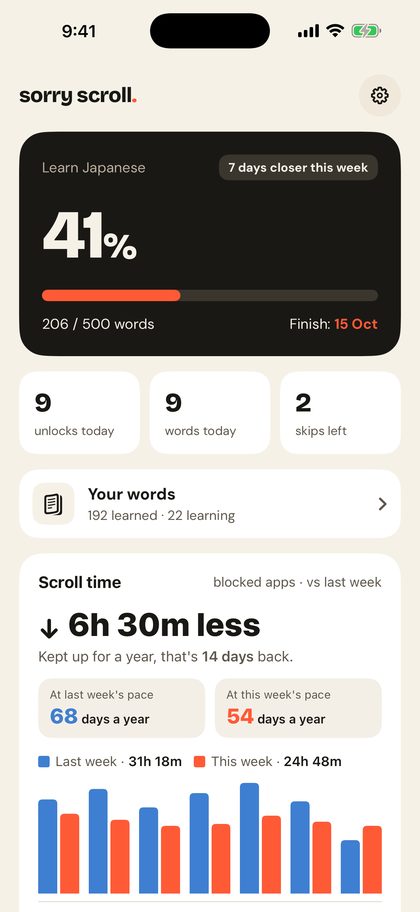 Watch it add up. Progress toward your goal, today's steps and skips, and your scroll time against last week. (Example data; the finish date is Pro.)
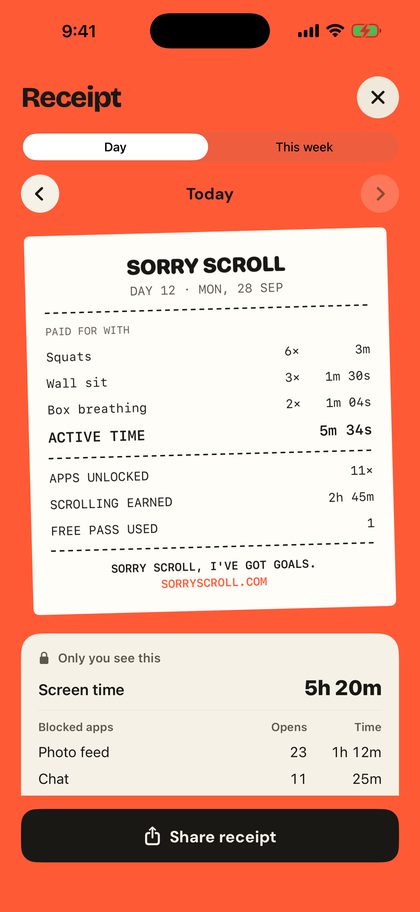 Get the receipt. With Pro, each day and week ends with a receipt of what your scrolling paid for, ready to share. (Example data.)
Pick what your scrolling pays for
A language
Two new words with audio and an example sentence, then a quick quiz. 6 languages, meanings in 7.
An active body
One guided move or breathing exercise, explained first, then a 30-second timer. No camera.
Other ways people try this
- Learning apps instead of social apps (Headway, Nibble, Duolingo): good content, but you have to choose to open them, and the scroll habit doesn't.
- Exercise-for-screen-time apps (Pushscroll, PushLock): the same idea for one goal, exercise.
- Habit-unlock apps (Habit Doom): your own habits earn the time. More flexible, more setup.
The full list is in app blockers that make you do something first.
Questions
Can you turn a scrolling habit into something useful?
Yes, if the useful thing sits in front of the habit. You keep opening the apps; each open costs 30 seconds of learning or moving first. You don't need willpower to start a session, because the habit starts it.
Isn't this just a learning app?
No. Learning apps like Headway, Nibble or Duolingo wait for you to choose to open them. Sorry Scroll puts the step in front of the app you were going to open anyway.
How much can I really learn?
With the language goal, about 500 words in 6 weeks at 25 opens a day, because new words are capped at 12 a day so reviews keep up. Try your own number in the calculator.
What if I need the app right now?
Use one of 3 daily skips, or close the app. The step is a price, not a wall.